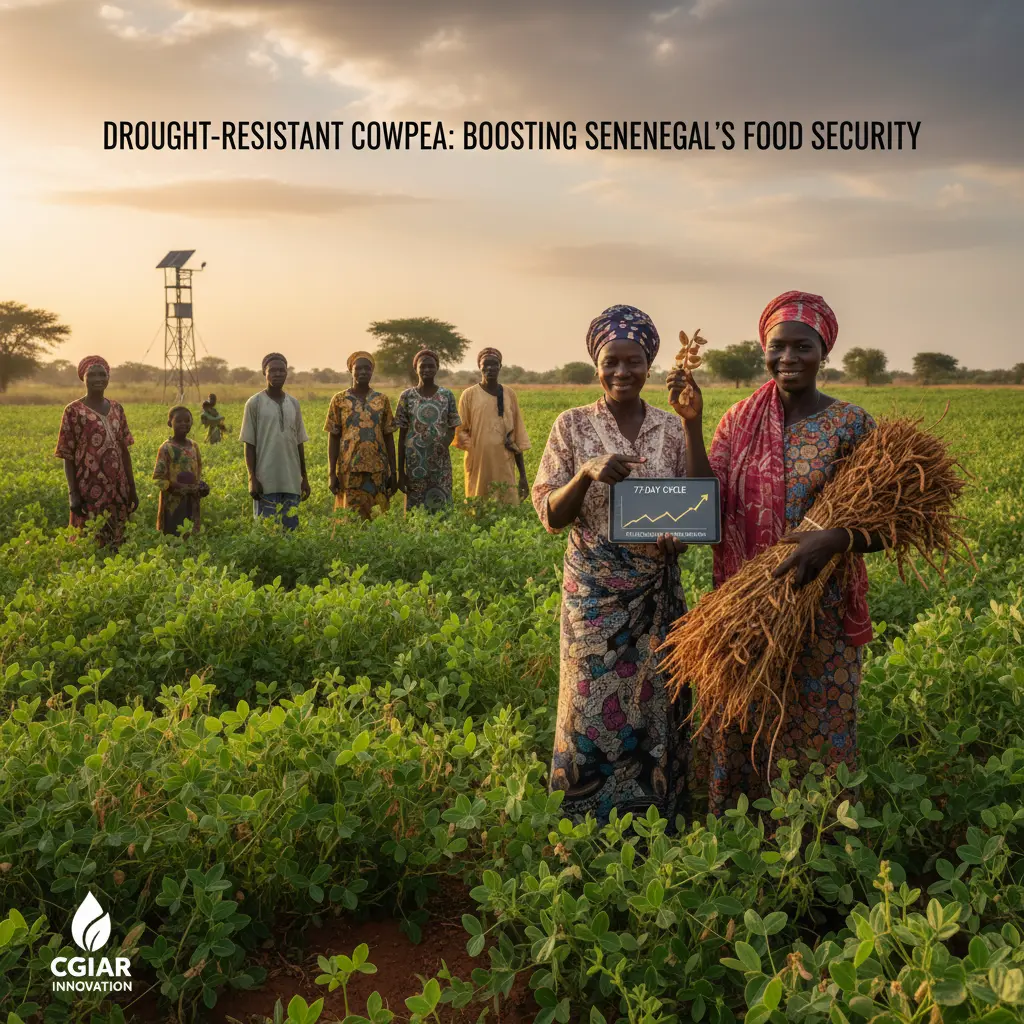
short-cycle and highly drought-resistant forage cowpea varieties to boost fodder and grain production for Senegalese farmers.
These new short-cycle (77-day) and highly drought-resistant forage cowpea varieties provide Senegalese farmers and livestock producers with a resilient solution for simultaneously producing high-quality fodder (4-5 tons of dry matter/ha) and nutritious grain (200-350 kg/ha), thereby enhancing their food security and income under challenging climati…

Location
Senegal

Innovation typology
Improved variety (CSA)

Scaling readiness
6 - Semi-Controlled Testing
Adapted and scaled context / What needs to be adapted?
this innovation has strong potential for wider deployment by policymakers and researchers, particularly due to its proven adaptation to semi-arid zones and short growth cycle. Tools such as technical data sheets, digital platforms, and farmer field schools can support its dissemination. The identified beneficiaries are agropastoralists in sub-Saharan Africa, for whom this resilient legume offers a sustainable solution to seasonal fodder shortages.
Realized/expected outcomes
The deployment of resilient forage cowpea varieties (Vigna unguiculata), such as 58-74 and IT98K-205-8, has enabled Senegal to produce 4-5 tonnes of fodder per hectare in just 55 days and 200-350 kg of grains, with a 77-day crop cycle and a net profitability of 166,667 FCFA/ha. This climate-smart innovation, tolerant to drought and adapted to rainfall levels of 300-1000 mm, enhances fodder security, strengthens the resilience of agropastoralists, and improves soil health through biological nitrogen fixation.
Intended beneficiaries/users
The forage cowpea innovation primarily benefits smallholder agropastoralists in semi-arid Africa who face seasonal fodder shortages. Highly compatible with local conditions due to its drought tolerance, short 77-day cycle, and suitability for intercropping, its sustained adoption requires complementary support through agronomic advice, climate information for optimal planting timing, and improved access to inputs and markets for surplus fodder.
Evidence
-
Cathy CLERMONT-DAUPHIN and al
https://hal.inrae.fr/hal-04927503v1/document -
Nadine W. and al
https://aiccra.cgiar.org/news/des-varietes-de-culture-double-usage-au-senegal-pourraient-ameliorer-la-production-laitiere-et -
Farm-level productivity of Millet, Groundnut, and Cowpea under climate- smart practices
https://hdl.handle.net/10568/137638